Capture to transform
Become your victim
A piece that captures takes on the moves of the piece it removed. A rook that takes a knight now moves as a knight — and the board redraws it as one.
Cannibal Chess starts from the board you know, then makes every capture a transformation. The capturing piece takes on the movement of the piece it just removed — a rook that eats a knight moves like a knight from then on, redrawn on the board as one. Identities chain and shift all game, and even the king cannibalises, though it never loses its crown.
A variant in the cannibal chess family — capture, and you inherit.
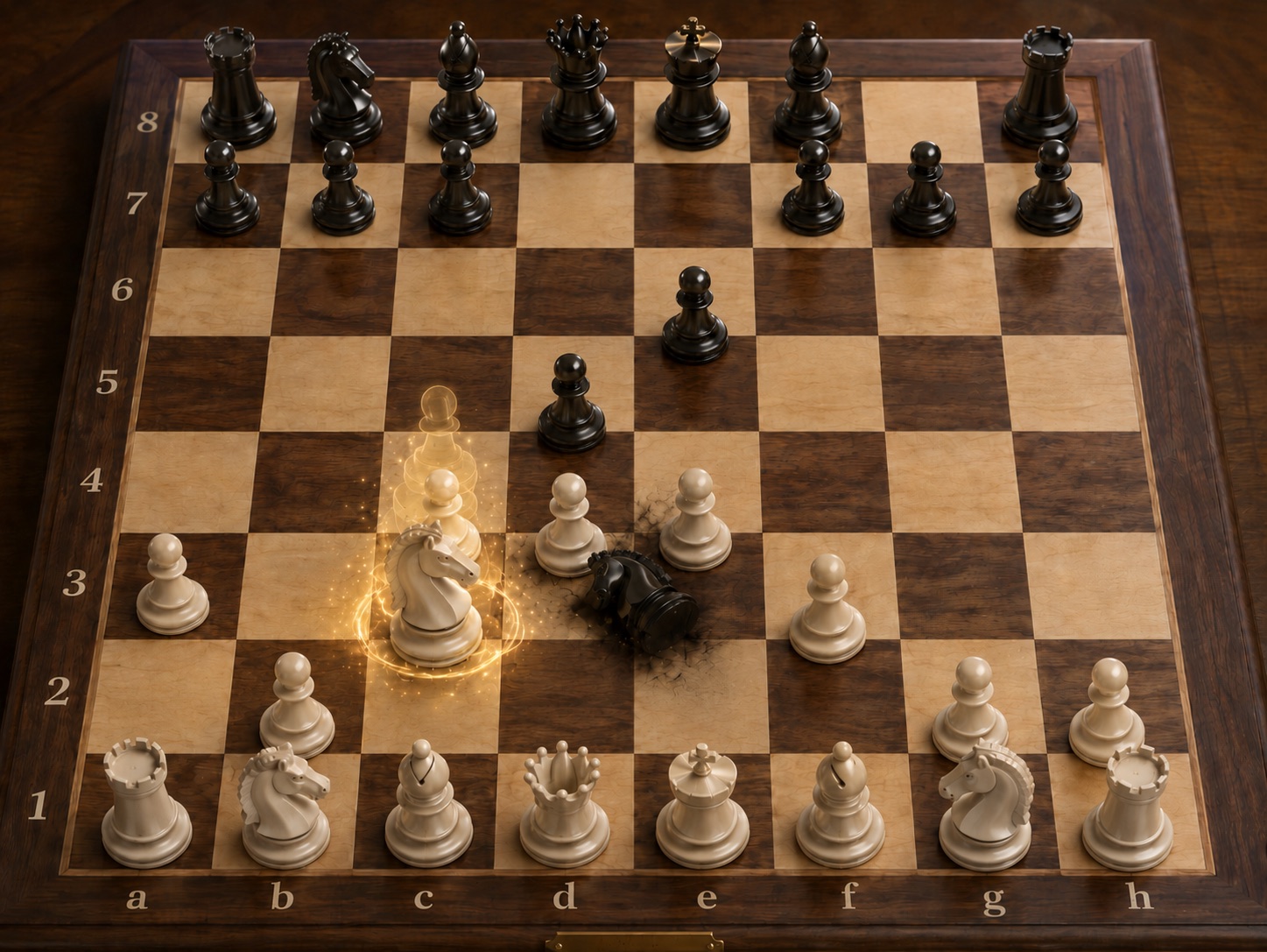
Capture, and your piece inherits its victim's moves — the board redraws it as the piece it ate.
When a piece captures, it stops being itself and becomes its victim. Every standard chess rule still applies — check, castling, en passant, promotion — but the pieces enforcing them keep changing shape. The one constant is the king: however it ends up moving, it is always the piece you must checkmate.
Become your victim
A piece that captures takes on the moves of the piece it removed. A rook that takes a knight now moves as a knight — and the board redraws it as one.
Nothing is final
That fresh knight can capture a bishop and become a bishop. Pieces drift through identities all game — plan two transformations ahead.
The classic way
A pawn that reaches the last rank with a plain, non-capturing push promotes to a queen, exactly as in standard chess.
Cannibalise instead
A pawn that reaches the back rank by capturing doesn't auto-queen — it cannibalises, becoming whatever piece it just took.
Only the originals
Castling needs an original rook under normal rules — and is off the table once the king has cannibalised something and no longer moves as a king.
Minimal pawn rules
A king moving as a pawn steps one square forward and captures diagonally only — no two-square opening, no en passant.
A king that captures inherits the victim's movement, yet it is still the piece you must checkmate.
Capture a pawn with your king and it now shuffles like a pawn — but it keeps its crown, and the game is still won by mating it. Push that royal pawn-king to the last rank and it is promoted: it gains queen movement and stays royal, so your opponent must now corner a piece that sweeps the board like a queen — at least until that queen, too, cannibalises something else.
Chess Upgraded is still growing. Donations help fund new variants, better visuals, mobile versions, and smarter computer opponents.
Fresh rule twists and new games beyond what's live today.
A custom visual identity beyond classic chess symbols.
Native-feeling mobile versions for quick matches anywhere.
Better bots that understand every variant and its wild endgames.
Cannibal Chess is a free, browser-based chess variant. It follows all standard chess rules, but when a piece captures another piece it takes on the movement of the piece it captured — a rook that captures a knight becomes a knight.
The capturing piece transforms into the piece it captured and, from then on, moves that way. The board redraws it as its new identity. Captures chain — that new knight can capture a bishop and become a bishop.
The king also takes on the captured piece's movement, but it stays royal — it is still the piece that must be checkmated. A royal piece moving as a pawn that reaches the last rank is promoted to queen movement and stays royal.
Castling is allowed only with the original rooks, under normal castling rules, and only while the king still moves as a king. Once the king has cannibalised another piece, it can no longer castle.
A pawn that reaches the last rank with a non-capturing push promotes to a queen as usual. A pawn that reaches it by capturing instead cannibalises the captured piece, becoming whatever it took.
Yes. Cannibal Chess is completely free and runs in your browser with no sign-up. You can play another person or a built-in computer opponent that understands the cannibal rules.
Try the demo, make your first capture, and watch your piece take on a brand-new identity.
Launch game